7 educational games to build logic and creativity (screen-free, from age 3)
Looking for simple, screen-free ideas that get both the brain and the imagination working? Here are 7 educational games that are easy to set up at home, designed for our children in French-speaking Switzerland, with variations by age and very little equipment.
 Michael Ambass
4 min read
Michael Ambass
4 min read
What parents are looking for (and what we had in mind)
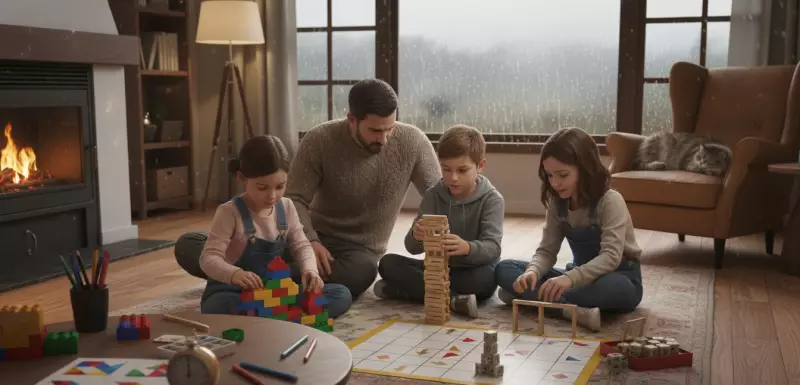
You want quick, screen-free ideas, adapted to each age, perfect for a rainy day and easy on the budget. And ideally using equipment you already have at home.
Simple equipment to have ready
- Wooden planks (Kapla-style), LEGO or Duplo
- Paper, scissors, felt-tip pens, sticky tape, sticky notes
- Story dice (or cut-out pictures), a printable tangram
- String and elastic bands, coins, a kitchen timer
How to choose by age and by the time you have
- 10–15 min: mini challenges, quick puzzles, stories from 3 pictures.
- 20–30 min: constructions, a coding course on the floor, free-form tangrams.
- 45 min and more: a mini escape game, big collaborative builds.
Our 7 favourite educational games
1) Building with wooden planks
You work on balance, symmetry and planning while giving imagination free rein. Express challenges: build tall, long, sturdy.
- 3–5 years: a simple bridge, sorting by size or colour.
- 6–8 years: the tallest tower using 30 planks.
- 9–12 years: recreating a monument from a photo.
2) Tangram and geometric puzzles
Perfect for spatial logic: you assemble, flip pieces over and try several strategies. A printed template is all you need.
- 3–5 years: silhouettes with the outlines drawn in.
- 6–8 years: animals with no outlines, a 3-minute timer.
- 9–12 years: invent a logo or a mandala and have the others guess it.
3) Story dice (or picture cards)
You stimulate language, the structure of a story and logical thinking (beginning, obstacle, solution) while having fun.
- 3–5 years: 3 dice, one sentence per die.
- 6–8 years: 6 dice, beginning-middle-end.
- 9–12 years: add a constraint (time, literary genre, rhyme).
4) Solo logic games (or DIY)
SmartGames-style: progressive challenges that build anticipation and problem-solving. Home-made version: a geoboard (a board and elastic bands) or matchstick puzzles.
- 3–5 years: simple stacking, colour paths.
- 6–8 years: Rush Hour Junior, paper mazes.
- 9–12 years: IQ Puzzler, Katamino, geometric challenges.
5) LEGO challenges
The goal: design, test, improve. You combine creativity and engineering thinking.
- 3–5 years: sorting by colour, A-B-A-B patterns.
- 6–8 years: build a 20 cm bridge that can hold a book.
- 9–12 years: a mechanism with gears or a timed catapult.
6) Unplugged coding on the floor
You tape a grid to the floor and program a route using arrows. Sequential logic, loops and debugging… with no screen.
- 3–5 years: go forward 5 steps, turn, reach the soft toy.
- 6–8 years: repeat a sequence 3 times, obstacles to avoid.
- 9–12 years: if/then conditions, two teams testing and correcting.
7) A mini home escape game
Riddles, codes and visual clues: you mix logic, observation and creativity. Pirate, space or jungle theme.
- 3–5 years: colour and picture clues, a 4-piece puzzle.
- 6–8 years: riddles, a number code hidden in a tangram.
- 9–12 years: a secret message (Caesar cipher), coordinates to decode.
Learning goals (what are we really aiming for?)
- Reasoning step by step and spotting patterns.
- Imagining, telling, representing and prototyping.
- Learning to test, fail, correct… and persevere.
Parents’ tips to make it really work
- Announce one clear, short challenge, then let them try.
- Vary the level: the same game, 3 versions depending on age.
- A playful timer (3–5 min) to keep up the pace and avoid the “we’re bored”.
- Finish with a “show moment”: presenting the build or the story.
Quick ideas (15 minutes or less)
- Kapla: build an arch that stands on its own.
- Tangram: complete 3 silhouettes against the clock.
- LEGO: create a vehicle with 10 pieces maximum.
- Geoboard: recreate 3 shapes with elastic bands.
- Story: 5 pictures drawn at random, 5 sentences.
Where to find things in French-speaking Switzerland
- Local toy libraries (Geneva, Lausanne, Fribourg, Neuchâtel, Valais): you borrow games for a few francs.
- Shops: Migros/Coop City, Manor, FNAC; online: Galaxus, Brack.
- Free printables: tangrams, coding grids, picture cards on educational websites.
Handy extras
- Masking tape on tiles or varnished parquet (it comes off cleanly).
- Put together a “challenge box”: dice, cards, timer, felt-tip pens.
- Keep a record of completed challenges: 5 stars = you choose the next activity.
To keep the learning going every day
Also discover how to turn a simple activity into a learning moment, at home, out and about or on public transport.