Summer toboggan runs in French-speaking Switzerland: which ride, from what age, and where to go as a family
A summer toboggan run is a mountain descent without snow: you settle onto a ride fitted with brakes and head down the slope at your own pace, from May to October. About ten sites in French-speaking Switzerland offer it, from age 2 or 3 with an adult. Here is where, at what price, and how to choose the right ride.
 Michael Ambass
15 min read
Michael Ambass
15 min read
What exactly is a summer toboggan run?
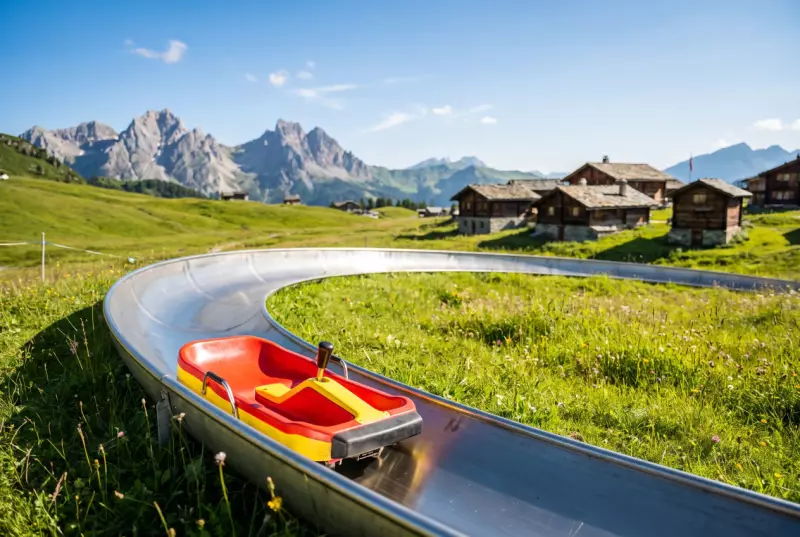
A summer toboggan run is a mountain descent made without snow, on a ride fitted with brakes that the passenger operates themselves. The principle comes down to one sentence: gravity does the work, you manage the speed.
Three families of ride share the name. The rail toboggan follows a metal rail from start to finish, so there is no way to leave the track. The giant slide runs down a long steel trough, on a small wheeled sledge. The mountain cart and the all-terrain scooter, meanwhile, roll freely along an alpine track.
That distinction changes everything when it comes to choosing. On rails, the ride is guided: a 3-year-old sitting in front of an adult cannot go off course. On a track, it is the rider who holds the line, hence the much higher minimum ages.
In French-speaking Switzerland and Valais, around ten sites offer one or other of these descents, from La Gruyère to the Val-de-Travers by way of the Vaud Alps.
Contents
- Which ride from what age: the table
- Minimum age or age to ride solo?
- The rail toboggan runs
- The giant slide at La Vue-des-Alpes
- Mountain cart and dévalkart
- The all-terrain scooter
- How much it costs
- Rain: which runs really close
- Safety: what is in place
- Special cases
- Common mistakes
- What to bring
- When to go
Which ride from what age: the table
| Ride | From what age | Riding solo | Minimum height | Indicative price |
|---|---|---|---|---|
| Rail toboggan | 2 to 3 years with an adult | 7 to 9 years depending on the site | no | 5 to 9 fr. per descent |
| Giant slide | 3 years with an adult | 8 years | no | 5 to 6 fr. per run |
| Dévalkart | no child passengers | yes, solo | 1.40 m | 6 fr. per run |
| Mountain cart | 11 to 12 years | yes, solo | 1.40 m | 20 fr. per descent |
| All-terrain scooter | around 8 years | yes, solo | able to brake | depends on the resort |
The prices are those published by the sites in our selection. They change from one season to the next: always check the official website before setting off.
Minimum age or age to ride solo?
Here is the point most parents discover on site, and it deserves to be stated plainly.
The minimum age displayed is almost always the age for riding with an adult, not the age for riding alone. Those are two different things, and the second one determines your budget.
A concrete example. At the Lac Noir toboggan run, the minimum age is 2. But up to age 7, the child rides accompanied by someone aged at least 16. So you pay an adult ticket and the child is free. From age 7, they set off alone: you pay two child tickets, or you stay at the bottom.
The same logic applies at the Luge Féeline at La Robella, where under-8s must be accompanied by someone aged at least 12. A 13-year-old big brother can therefore take his little sister, which frees up the parents. At the Alpine Coaster at Glacier 3000, the accompanying person must be at least 9, and solo riding starts at 9 with a height of 1.40 m.
Remember the rule: on rails, solo riding starts between 7 and 9. On wheels, the 1.40 m height matters more than the age.
The rail toboggan runs
This is the format most accessible to young children, and the one we recommend for a first time.
Luge Féeline at La Robella, in Buttes (Neuchâtel). 1,200 metres of rails suspended above the Val-de-Travers, including about 300 metres of ascent and 900 metres of descent. Accessible from age 3 with an adult. Expect from 7 fr. per adult run and 5 fr. per child run, with an unlimited Féeline Pass from 30 fr. for a morning. Free for under-8s. Open from April to October, daily in high summer, roughly from 9.30am to 5.30pm. A big advantage: you board at the bottom of the resort, with no chairlift, and the Buttes CFF station is right next door.
Lac Noir toboggan run, in Schwarzsee (Fribourg). About 1,000 metres on rails facing the mountain lake, in the Fribourg Prealps. Minimum age 2, solo from 7. One way 7 fr. for adults and 5 fr. for children aged 7 to 15, with cards of 5 descents for 32 fr. and 10 descents for 55 fr. Open from May to October, daily in July and August, roughly from 10.30am to 7pm. A café beside the run, the Rodel-Träff, lets parents watch the descents sitting down.
Parc de loisirs de Moléson (Fribourg). A rail toboggan from age 3 accompanied, alone from age 8, plus a dévalkart and a minigolf course on the same site. One run costs 6 fr., dropping to 4.50 fr. from 20 runs. Accompanied 3 to 7 year olds ride the toboggan free. Free parking five minutes’ walk away, buses from Gruyères or Bulle.
Feeblitz, in Saas-Fee (Valais). A rail toboggan winding between forest and rocks, with a chairlift up. From age 3 accompanied, solo at around 8 depending on height and the rules of the day. Allow 30 to 60 minutes on site. As Saas-Fee is a car-free village, you leave the car at the entrance car park and then walk 10 to 15 minutes.
Alpine Coaster at Glacier 3000, in Les Diablerets (Vaud). The highest rail toboggan in Europe, about 1 kilometre, perched at nearly 3,000 metres. From age 3 accompanied by someone aged at least 9, solo from 9 with a height of 1.40 m. A descent costs 9 fr., or 36 fr. for five (the fifth is free). On top of that comes the pedestrian pass to get up: 89 fr. for adults, 45 fr. for children aged 6 to 15, free under 6. It is the most expensive outing in the selection, but it includes the Peak Walk and the walk on the glacier.
The giant slide at La Vue-des-Alpes
A format of its own, and probably the best fun-to-price ratio in the region.
At the La Vue-des-Alpes pass, on the Neuchâtel heights, you head down a long metal trough on a small wheeled sledge, brake lever in hand. From age 3, accompanied by an adult up to 7, solo from 8.
A run costs 5 fr. for a child and 6 fr. for an adult, with booklets of 3, 5 or 10 runs. Accompanied 3 to 7 year olds ride free. Opening hours: 1pm–6pm Monday to Friday, 10.30am–6pm at weekends, during the school holidays and on public holidays.
One point to watch: the run closes in the rain, and there is no direct train. You get there by car, or by bus from La Chaux-de-Fonds station.
Mountain cart and dévalkart
The mountain cart is a three-wheeled, engine-free machine, halfway between a toboggan and a go-kart. You go up by gondola and come down a mountain track. It is physical, and it is reserved for older children.
Mountain Cart in Villars-sur-Ollon (Vaud). 5 kilometres and 700 metres of descent from the top of the Roc d’Orsay down to the village, on the Bouquetin track. From age 12 and 1.40 m. A full loop, including the way up, takes about an hour. One descent costs 20 fr., two descents 35 fr., plus the gondola at around 15 fr. (free with the Magic Pass). Online booking is compulsory, with five departures a day at 10am, 11.30am, 1pm, 2.30pm and 4pm. Turn up 10 minutes beforehand.
Mountain Cart in Crans-Montana (Valais). A descent between Arnouva, at around 1,700 metres, and Montana. From age 11 and 1.30 m. Watch out for the administrative conditions: 11 to 17 year olds need a waiver signed by their legal guardian on site, and 11 to 15 year olds cannot take part unless accompanied by an adult. Bring identity documents. Helmet compulsory and included in the hire, gondola ride included. Open from 4 July to 13 September 2026.
The dévalkart at Moléson. A short, inexpensive version of the concept: more than 500 metres of off-road track, a ski-lift back up, compulsory helmet, one person per kart. The only criterion is height, 1.40 m. At 6 fr. per run, it is the most affordable way in for a teenager who wants to try.
The all-terrain scooter
Big wheels, handlebars, bicycle brakes: the downhill scooter is ridden standing up on a wide alpine track. It requires being comfortable on two wheels and able to brake unaided, which generally puts it from age 8 upwards.
Trott en Stock, in Champéry (Valais). A guided descent from the heights of the Portes du Soleil, with a gondola up. Allow 1.5 to 2 hours in total. Booking is strongly advised, as slots go quickly in summer. By train: CFF to Aigle, then AOMC to Champéry, a few minutes’ walk from the gondola.
Giant scooter in Loèche-les-Bains, Torrent area (Valais). Gondola up to Rinderhütte, then down towards Flaschen on a wide, rolling alpine road. The descent takes 20 to 40 minutes depending on pace, 1 to 1.5 hours including the ascent. One scooter per person, no passengers. Helmet provided with the hire.
Supervision is what sets the two formats apart. In Champéry, a guide accompanies the group and adapts the route to the level, which is reassuring for a first time. In Loèche-les-Bains, you ride down independently after a briefing.
How much it costs
A descent costs between 5 and 9 francs on rails, and around 20 francs by mountain cart. The real expense is not the first descent: it is the sixth.
Because your children will want to go again. That is in fact the sign of a successful outing.
The calculation that changes the bill. At Moléson, one run costs 6 fr. A family of four doing five descents each adds up to 20 runs. Individually, that would be 120 fr. At the reduced rate of 4.50 fr. from 20 runs, the bill drops to 90 fr. Thirty francs’ difference for a single box ticked at the counter.
Three useful reflexes:
- Buy the booklet on arrival, not after the third descent. Reduced tiers exist at Moléson (from 4, 10 then 20 runs), at Lac Noir (5 or 10 descents), at La Vue-des-Alpes (3, 5 or 10 runs) and at Glacier 3000 (the 5th descent free).
- Check whether the lift is included. At Villars, the cart price does not include the gondola. At Crans-Montana, it does.
- Count the free places. Under-8s at La Robella, under-7s at Lac Noir, accompanied 3 to 7 year olds at Moléson and La Vue-des-Alpes all go free. With two young children, the outing becomes very affordable.
The Magic Pass, for its part, covers the Roc d’Orsay gondola at Villars. If you already have one, the price gap with the other sites narrows considerably.
Rain: which runs really close
Not all runs react to the weather in the same way, and this is rarely explained.
The runs that close in wet weather are those where water changes grip or visibility: La Vue-des-Alpes closes in the rain, Lac Noir only operates in dry weather, and Feeblitz suspends operations in rain, storms or strong wind. Mountain carts and scooters, which roll on earth, are suspended or discouraged as soon as the track is soaked.
The Luge Féeline at La Robella, however, stays open in all weathers. Its rails are suspended above the ground. After rain the course becomes more slippery and you have to brake more, but the run keeps going. It is your plan B when the sky is uncertain.
In every case the reflex stays the same: check that day’s opening on the official website before getting in the car. A mountain run can be closed while the sun is blazing down in the valley, and the reverse happens too.
Safety: what is in place
The question comes up often, and the answer is reassuring provided you understand what protects the child.
On rails, the line is fixed. The toboggan cannot leave the rail, every vehicle has a brake lever and, on suspended models such as the Féeline, seat belts. The only real risk is colliding with the toboggan in front, hence the spacing instruction repeated at the start. Say it to your child before they set off alone, not as they are leaving.
On wheels, a helmet is compulsory and provided: that is the case at the Moléson dévalkart, on the mountain carts at Crans-Montana, and on the scooters at Champéry and Loèche-les-Bains. The departure briefing is not a formality; it explains the braking specific to each machine.
A controlled descent activity is not an activity without rules: it is an activity where the child learns to modulate for themselves, which is precisely the point.
Special cases
If your child is under 3. No run in our selection accepts the very youngest, with the exception of Lac Noir, which sets the minimum at 2. Below that, it is better to aim for a different kind of outing and come back the following year.
If you are looking for the cheapest outing. La Vue-des-Alpes, with its runs at 5 and 6 francs and free rides for accompanied 3 to 7 year olds, comes top. Moléson follows closely thanks to its reduced rates and free parking.
If you don’t have a car. The Luge Féeline in Buttes is the outright champion: the CFF station is right by the resort, and there is no lift to take. Champéry is reachable by AOMC from Aigle, Villars by TPC from Bex, Crans-Montana by funicular from Sierre. La Vue-des-Alpes is the least well served, with no direct rail link.
If the weather is bad. Head for La Robella, the only run in the selection described as open in all weathers.
If you are short of time. Feeblitz can be done in 30 to 60 minutes. A descent at La Vue-des-Alpes or Lac Noir takes a few minutes. By contrast, the Villars mountain cart takes about an hour per loop, and Glacier 3000 needs at least half a day.
If your teenagers find toboggans too childish. Move up to the Villars mountain cart, 5 kilometres and 700 metres of descent, or the guided scooter in Champéry. Changing the machine is enough to change the experience completely.
If your children are very different ages. Moléson is the best answer: a rail toboggan from age 3 for the little ones, a dévalkart from 1.40 m for the older ones, and minigolf to catch your breath in between. Glacier 3000 also works, with the Alpine Coaster accessible from age 3 accompanied and the Peak Walk for everyone.
Common mistakes
- Setting off without checking that day’s opening. By far the number one mistake. A mountain run can close for rain, wind, maintenance or an early end of season.
- Confusing the minimum age with the age for riding alone. A 5-year-old can do La Vue-des-Alpes, but sitting in front of an adult, not by themselves.
- Forgetting the height requirement. The 1.40 m for dévalkarts and mountain carts is not negotiable at the counter. Measure your child before booking, not on site.
- Paying per run. Three descents bought separately cost more than a booklet, and your children will do more than three.
- Underestimating the cold at altitude. At 3,000 metres at Glacier 3000, it is chilly even in high summer. A windproof jacket fits in a rucksack.
- Turning up in sandals. Closed shoes are required everywhere, and you will be turned away without them.
- Not booking where it is compulsory. Villars works on fixed slots with online booking. Turning up on the off chance means risking going home empty-handed.
What to bring
A short checklist, valid at every site:
- Closed shoes, for everyone
- A windproof jacket, even when it is 30 degrees in the valley
- Sunscreen and sunglasses; the glare is strong at altitude
- A water bottle and a snack
- Something to tie back long hair
- Identity documents if you are taking a minor on a mountain cart at Crans-Montana
- A little cash, as some mountain counters remain temperamental
When to go
The season broadly runs from May to October, with variations depending on altitude. La Robella operates from April to October, Lac Noir from May to October, and Glacier 3000 runs its summer operations from roughly early May to mid-October. The Crans-Montana mountain cart is limited to high summer, from 4 July to 13 September 2026.
July and August guarantee daily opening. In May, June, September and October, hours become variable and some installations only operate at weekends.
As for the time of day, the morning almost always wins: less waiting, a track that dries earlier after the dew, and fresher children. On weekdays outside the holidays, the afternoon stays very quiet at most sites.
In short
The summer toboggan run is one of the rare mountain activities that a 3-year-old and a 15-year-old can agree on. You just have to choose the right ride: on rails for the little ones, on wheels for the older ones.
If you were to remember only three addresses: La Robella in Buttes for its all-weather reliability and rail access, La Vue-des-Alpes for its unbeatable price, and Villars to thrill the teenagers. Check that day’s opening, buy the booklet rather than single runs, slip a jacket into the bag, and let your children work the brake themselves. That is where the pleasure lies.
Receive our best outing ideas
Want more family outing ideas in French-speaking Switzerland? Join the 1000+ families who receive our best activities every week, sorted by age, season and region. Sign up to the Kidora newsletter, it’s free.