Autumn forest walks with children: our ideas in French-speaking Switzerland
Autumn is the best season for taking children into the forest: the colours, the chestnuts, the rutting stags and temperatures that are perfect for walking. Here are our routes in French-speaking Switzerland, what to look for with children, and the two safety points specific to the season.
 Michael Ambass
5 min read
Michael Ambass
5 min read
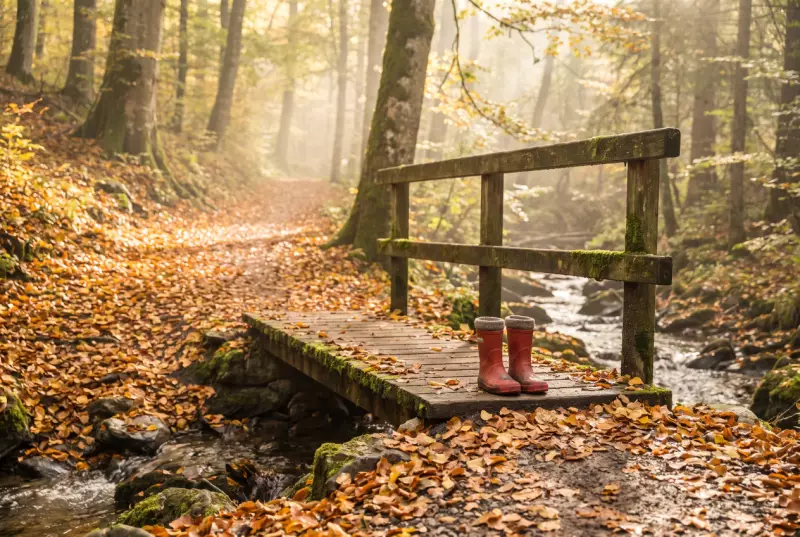
In October, the forest becomes the best playground in French-speaking Switzerland: colours, chestnuts to gather, mushrooms to look at, and a temperature that is finally ideal for walking with children.
It is also the season when a walk becomes easy to “sell” to children: there is something to bring home in their pockets. Here are our routes, what to look for depending on age, and the two autumn-specific safety points that few guides mention.
Why autumn beats summer in the forest
Four concrete reasons:
- The temperature. Between 12 and 18 degrees, children walk without complaining about the heat. In July, the same walk is an ordeal.
- There is something to gather. Chestnuts, acorns, beechnuts, leaves, husks, pine cones: a 4-year-old can spend a whole hour filling a bag.
- The sites are empty. The busiest summer trails become quiet again from mid-September.
- The rutting stags. From mid-September to mid-October, stags bellow. It is an impressive sound, sometimes heard at dusk from a forest path. For a 7 to 10 year old, it is a powerful memory.
Our routes in French-speaking Switzerland
Themed nature trails: walking with a goal
This is the most effective format in the forest, because the walking is never the point: you follow boards, you search, you answer questions.
- The nature trail in the forêt des Arses in Rougemont — short, well laid out, magnificent in October in Le Pays-d’Enhaut.
- Our full selection of themed nature trails for children.
Gorges and waterfalls: autumn suits them
In autumn, the flow is often gentler than in spring and the trails are dry. It is the best window of the year.
- La Tine de Conflens in La Sarraz — ten minutes’ walk to a rocky amphitheatre where two rivers meet. Free, from age 3.
- The Chauderon gorges in Montreux — a genuine mountain hike from age 7, with the option of returning by train.
- The Vièze gorges in Monthey — a tunnel and a suspension bridge, free, from age 5 to 6.
- The Môtiers waterfall and its cave — in the Val-de-Travers, with a cave to explore by lamplight.
- Our whole selection: gorges and waterfalls as a family.
One seasonal point to watch: after the first autumn rains, gorge walkways and steps become very slippery, and fallen leaves hide the roots. Good soles are essential.
Forests where you meet animals
- The deer park in Leysin — animals to watch up close with no walking, perfect with the youngest.
- The marmot park in Anzère — to see before hibernation: in early October, the marmots are getting ready to disappear for the winter.
- Our farms and animal parks and the Nature & Animals category.
With a stroller
Autumn complicates forest paths: mud, leaves, roots. Our selection of stroller-friendly walks favours hard surfaces, which stay passable all season.
What to look for in the forest, by age
- 0–3 years: gathering leaves and pine cones, hearing the sound of footsteps in fallen leaves. The outing lasts thirty minutes and that is absolutely fine.
- 3–5 years: building a den out of branches, making land art with leaves, hunting for chestnuts in their husks. See our 3–5 ideas.
- 6–9 years: identifying trees by their leaves, observing mushrooms without touching them, looking for animal tracks in the mud. Our 6–9 ideas.
- 10–12 years: leading the route with the map, going out at dusk to listen for the stags, taking photographs. Our 10–12 ideas.
The two safety points specific to autumn
These are the two things most often forgotten, and they really matter.
Hunting
In autumn, the hunting season is open in several cantons in French-speaking Switzerland, with periods and rules that vary from one canton to another and sometimes from one region to another. Three reflexes: stay on waymarked trails, dress children in bright colours, and check the hunting periods with the cantonal wildlife service before heading into a quiet forest area. Some zones are subject to temporary restrictions.
Night falling early
In October, it gets dark around 6.30pm, and in the forest the light fades a good half hour earlier than in the open. Allow plenty of margin for your return, and slip a head torch into the bag — it also turns the end of the walk into an adventure for children.
Mushrooms and chestnuts: the simple rule
Autumn makes you want to gather things, and it is an excellent activity — provided you set a clear rule from the outset.
- Mushrooms: look, don’t eat. That is the only workable instruction with children. Several toxic species look a great deal like edible ones. Cantons also apply picking rules (quantities, closed days) that vary: check the ones in your canton.
- Chestnuts, yes, but only sweet chestnuts — not horse chestnuts, which are not edible. The difference is easy to teach children: the sweet chestnut husk bristles with long, closely packed spines, while the horse chestnut has thick, widely spaced spikes.
The kit that changes everything
- Boots or shoes with grip, and spare socks in the bag.
- Layered clothing: it is chilly at the start, warm on the way up, chilly again when you stop.
- A bag or a basket for the treasures. It is the object that motivates 3 to 6 year olds most.
- A head torch, even for an afternoon walk.
- A thermos. A hot chocolate break on a tree trunk beats every other form of motivation.
And when it really is too wet
A light drizzle in the forest is pleasant, but some days are a write-off. Our alternatives: caves and mines, where the weather makes no difference, interactive museums and our ideas for rainy days.
To plan a whole week, see the autumn holiday dates canton by canton. And so you are never short of ideas, join the 1000+ families subscribed to our weekly newsletter.